
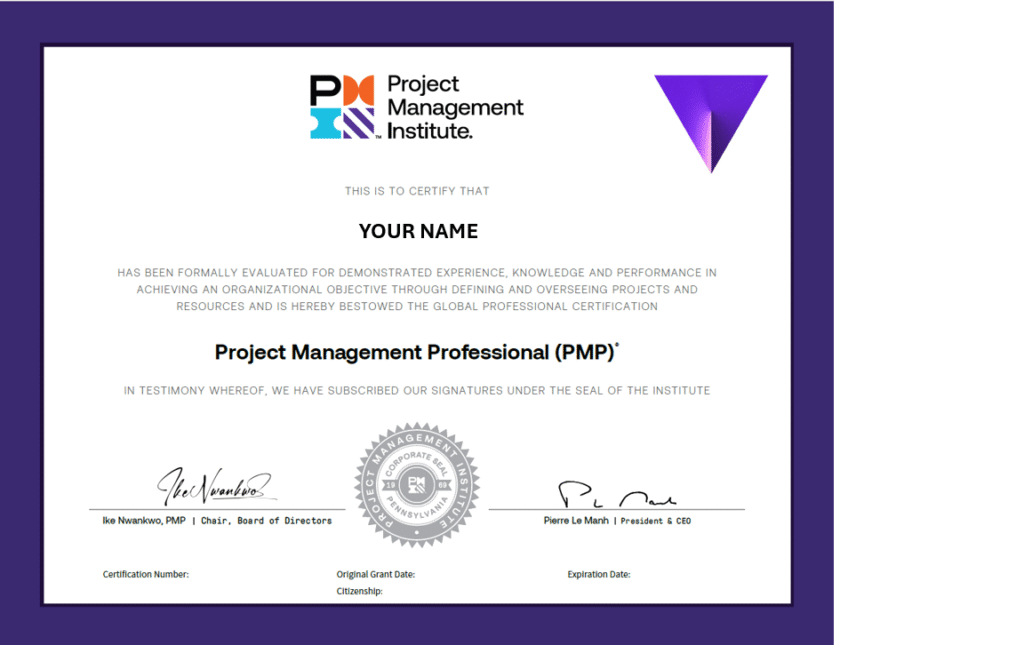

When I set out to earn my Project Management Professional (PMP)® certification, I knew it would test more than my knowledge — it would test my discipline. Managing a demanding full-time corporate job while preparing for one of the world’s toughest project professional exams was no easy feat.
The PMP is held by over 1.4 million professionals worldwide and is recognized as the gold standard in project leadership. According to PMI’s 2024 Salary Survey, PMP-certified professionals earn 32% more on average than their peers. Unlike many academic or theoretical degrees, the PMP is built on practical leadership, real-world decision-making, and value delivery, skills that separate managers from true project leaders.
After six focused and structured months, I passed on my first attempt. Here’s the exact strategy I used — and how you can replicate it.
The Decision Why I Took the PMP
As a professional in corporate job, managing complex projects and strategic initiatives, I wanted a globally recognized certification to formalize my skills and open doors to more strategic roles.
The PMP represents not just project management knowledge, but the ability to lead teams, drive results, and deliver value (Benefits realization).
But with a full-time day job, I knew I had to manage this like a project itself, structured, goal-driven, and realistic.
PMP Examination Requirements ( Eligibility)
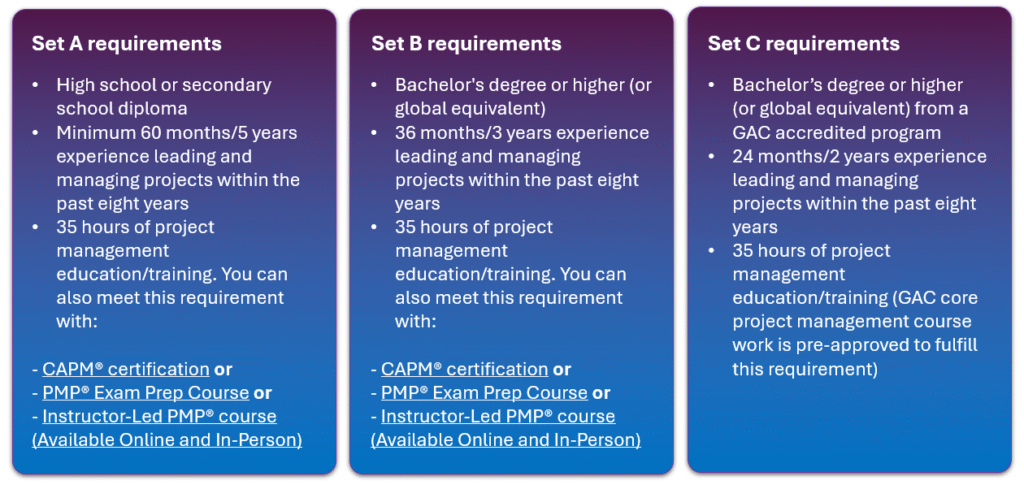
To qualify for the Project Management Professional (PMP)® certification, PMI requires candidates to demonstrate both education and practical project leadership experience. There are three eligibility pathways based on academic background and project management exposure:
The Plan: Treating the PMP Like a Project
One of the first things I realized when preparing for the PMP is that there is no single, structured study approach defined by PMI itself. Both the PMBOK® Guide (7th Edition) and the Process Groups: A Practice Guide provide valuable frameworks, but neither serves as a step-by-step manual for passing the exam.
That’s why the real foundation of the exam, and your preparation, must be the PMP Examination Content Outline (ECO). The ECO defines exactly what PMI will test you on, across three domains:
| DOMAIN | PERCENTAGE OF ITEMS ON TEST |
| People – leading, motivating, and empowering teams | 42% |
| Process – applying predictive, agile, and hybrid delivery approaches | 50% |
| Business Environment – aligning projects with organizational strategy and value creation | 8% |
| Total | 100% |
Below was my six-month roadmap, practical, structured, and tailored to balance my professional and personal schedule.
| Phase | Duration | Focus |
| Learning Foundational Concepts | Month 1 | Review the PMP eligibility requirements, understand the Exam Content Outline (ECO), and align your learning with the three PMP domains — People, Process, and Business Environment. Study PMI’s Code of Ethics, core definitions, and the PMBOK Guide (7th Edition) performance domains. |
| Project Integration Management | Month 2 | Learn how project components are unified and aligned to deliver organizational value. Understand developing a project charter, project plan integration, directing and managing project work, monitoring, and performing integrated change control. |
| Project Scope Management | Month 2 | Study how to define and control project scope. Focus on collecting requirements, defining scope, creating a Work Breakdown Structure (WBS), validating, and controlling scope in both predictive and adaptive environments. |
| Project Schedule Management | Month 3 | Master the processes that ensure timely project completion: defining activities, sequencing them, estimating durations, developing and controlling the schedule. Learn schedule compression and adaptive iteration planning. |
| Project Cost Management | Month 3 | Understand planning, estimating, budgeting, financing, funding, managing, and controlling costs so projects are completed within the approved budget. Emphasize Earned Value Management (EVM) and cost forecasting. |
| Project Quality Management | Month 4 | Learn planning, managing, and controlling quality based on both organizational and customer requirements. Review quality assurance, continuous improvement, and cost of quality concepts. |
| Project Resource Management | Month 4 | Explore planning, estimating, acquiring, developing, and managing the project team. Connect this to the People domain: motivation, leadership styles, and conflict resolution. |
| Project Communications Management | Month 5 | Study planning, managing, and monitoring communications to ensure timely and appropriate information flow. Focus on stakeholder communication models and escalation processes. |
| Project Risk Management | Month 5 | Review identifying, analyzing, planning, implementing, and monitoring risk responses. Learn to recognize opportunities and threats across predictive and adaptive life cycles. |
| Project Procurement Management | Month 6 | Study planning, conducting, controlling, and closing procurements. Understand contract types, procurement strategies, and managing relationships with external suppliers. |
| Project Stakeholder Management | Month 6 | Master identifying, analyzing, and engaging stakeholders throughout the project life cycle. Emphasize expectation alignment, influence, and continuous engagement to support value delivery. |
Every week, I scheduled 1–2 hours daily sometimes during lunch hours on weekdays and 4–5 hours on weekends. Evenings became study time, and I treated it as a non-negotiable appointment with my goals.
Study Resources I Used
Preparing for the PMP requires selecting high-quality, PMI-aligned materials that reflect both the PMBOK® 7th Edition principles and the Examination Content Outline (ECO).
Below are the resources I used throughout my six-month study journey:
Purpose: The foundation of modern project management principles. It focuses on performance domains, tailoring, value delivery, and systems thinking, rather than prescriptive processes.
Process Groups: A Practice Guide
Purpose: Complements PMBOK 7 by bridging the shift from process-based to principle-based management. It details the five process groups (Initiating, Planning, Executing, Monitoring & Controlling, Closing) and aligns them to the 10 knowledge areas, a vital link for exam situational questions.
Agile Practice Guide (by PMI and Agile Alliance)
Purpose: Essential for understanding Agile, Scrum, Kanban, and hybrid approaches tested heavily in the current PMP exam. It provides guidance on servant leadership, iteration planning, and adaptive life cycles.
PMP Examination Content Outline (ECO)
Purpose: The official blueprint for the PMP exam. It defines the three domains (People, Process, Business Environment), their tasks and enablers, and how each contributes to PMI’s Value Delivery System.
Microsoft Project Management: Build Job-Ready Skills Professional Certificate (Coursera)
Purpose: A practical online specialization that reinforces planning, scheduling, risk, and stakeholder management using Microsoft Project tools. It bridges academic theory with applied execution, mirroring real project environments.
Instructor-Led PMP Exam Prep (PMI Authorized Training Partner options) + On-Demand Video Course
Purpose: Live instruction via PMI ATPs (choose virtual or in-person) and/or structured on-demand video. Check out the PMI – Authorized PMP® Exam Prep Course (catalog of PMI-developed options).
PMI Study Hall® Essentials (Subscription)
Purpose: PMI’s official practice environment with questions, full exams, progress tracking, and gamified activities; creates a plan based on your exam date. Pricing varies by region; Essentials and Plus tiers are available.
Additional Free Learning Resources
Ricardo Vargas (YouTube) – Renowned PMI author who explains project models and visual frameworks.
David McLachlan (YouTube) – Detailed PMP exam strategy, mindset, and simulation guidance.
Andrew Ramdayal (YouTube & Udemy) – Known for high-yield question analysis and simplified agile explanations.
These resources collectively ensured balanced coverage of PMI’s mindset, principles, and practice domains. While the PMBOK® 7th Edition and ECO guided what to learn, simulators, courses, and interactive tools guided how to think and apply, a critical distinction for passing the PMP on the first attempt.
Final Thought: Discipline Over Motivation
Looking back, passing the PMP on my first attempt was not about studying harder — it was about studying smarter, with structure, intent, and the right mindset. The PMP isn’t a test of memory; it’s an assessment of how you think, lead, and deliver value.
